
BMG Research has undertaken exclusive polling for The i newspaper. The polling covers topics including vote intention, leader satisfaction, the budget and British attitudes to the US Presidential election.
Analysis by Robert Struthers – Head of Polling at BMG
Our post-budget polling underlines just how tough the early months of a Labour government are shaping up to be. In the days after Rachel Reeves finished delivering her first budget, our polling shows Labour already trailing the Conservatives, albeit marginally.
This is with the Conservatives yet to elect a new leader—they’ve managed to take a poll lead simply by letting Labour govern.
While they may be statistically tied when accounting for the margin of error, the Conservatives’ slight lead signals early challenges for Labour. The lead is certainly symbolically and psychologically important —this is the first Conservative lead we’ve recorded in over three years.
And though this may be early in the parliament, what should concern the party is that it appears to be splintering support in nearly every direction. Almost three in ten who voted Labour just a few months ago would not commit to backing Labour if an election were held tomorrow. This cohort includes many who are now undecided, but also sizeable minorities that would also say they would back the Conservatives, Liberal Democrats, and Reform.
Starmer’s personal ratings have dropped and are now close to where Sunak’s were before the election—who himself was a deeply unpopular PM by the time he left office.
This is a stark contrast to the last Labour leader who entered Downing Street for the first time off the back of a landslide victory; at the same point in his term, Blair was riding high in the polls.
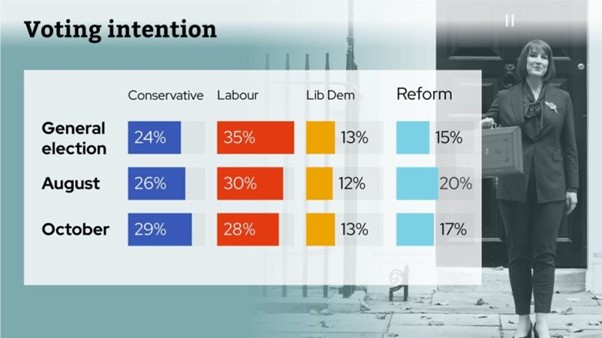
| Conservative | Labour | Lib Dem | Reform | |
|---|---|---|---|---|
| General Election | 24% | 35% | 13% | 15% |
| August | 26% | 30% | 12% | 20% |
| October | 29% | 28% | 13% | 17% |
An article by The i on the dissatisfaction with the Labour party in government can be found here.
Methodology, fieldwork dates, and a full breakdown of these results can be found here.
As a sample of the population was interviewed, the results are subject to a margin of error around various estimates. This means that, given the random nature of the sampling process, we can be confident that the actual result lies somewhere within the margin of error. For example, with a sample of 1,000 we can be 95% certain that the actual value will fall 3% either side of the result. For a more detailed breakdown of results from this poll, or any other results from our polling series, please get in touch by email or phone.